Page
Two
<< Go
to Page One
Sunday
A big day today! Matthew and I rode the train downtown and began a hike on the west side of the large City Park called the Tiergarten. First, thou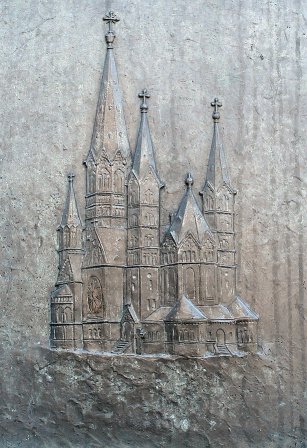 gh, we saw
 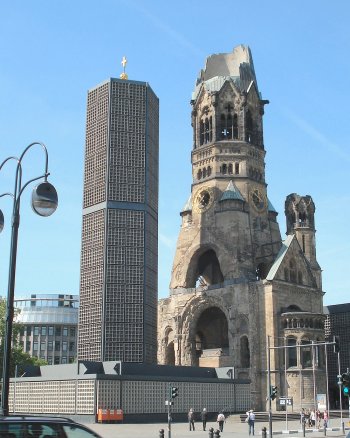 the ruins of the Kaiser Wilhelm Memorial Church --
unrestored large part of a grand "king's" church. The church was built
by Kaiser Wilhelm II and its title was given in honor of his
grandfather Kaiser Wilhelm I. The foundation stone was laid on March
22, 1891, Wilhelm I's birthday. Designed by Franz Schwechten, who
planned a large church in neo-Romanesque style, the church was
consecrated on September 1, 1895, but the entrance hall in the lower
section had not been completed. It was opened and consecrated on
February 22, 1906. The church was badly damaged in an air raid on the
night of November 23, 1943. The ruins have been left standing as a
memorial to the destruction of Berlin during WWII. A new tower stands
side by side with the ruins. A plaque on the ruin shows how the
original church looked.
the ruins of the Kaiser Wilhelm Memorial Church --
unrestored large part of a grand "king's" church. The church was built
by Kaiser Wilhelm II and its title was given in honor of his
grandfather Kaiser Wilhelm I. The foundation stone was laid on March
22, 1891, Wilhelm I's birthday. Designed by Franz Schwechten, who
planned a large church in neo-Romanesque style, the church was
consecrated on September 1, 1895, but the entrance hall in the lower
section had not been completed. It was opened and consecrated on
February 22, 1906. The church was badly damaged in an air raid on the
night of November 23, 1943. The ruins have been left standing as a
memorial to the destruction of Berlin during WWII. A new tower stands
side by side with the ruins. A plaque on the ruin shows how the
original church looked.
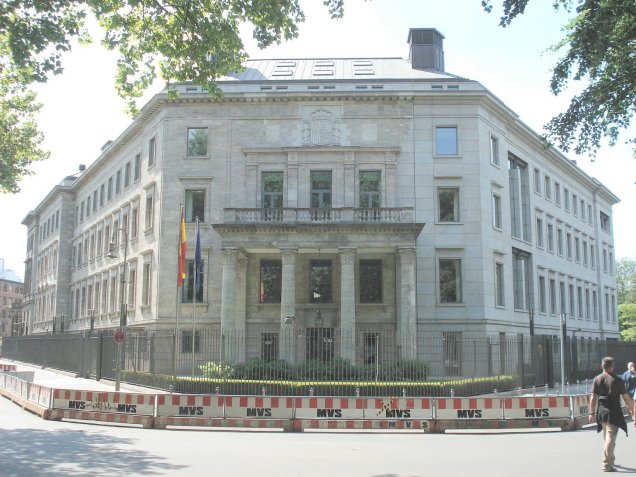
 Then, we walked by
the Zoo. Located on the southwest side of the Tiergarten, entrance to
the Zoo is made through the famous elephant gate. We walked along the
side of the Zoo and were able to catch glimpses of some of the animals
including llamas and an ostrich, among other exotic animals. That
brought us to the edge of the Tiergarten at a place where the Spanish
Embassy is.
Then, we walked by
the Zoo. Located on the southwest side of the Tiergarten, entrance to
the Zoo is made through the famous elephant gate. We walked along the
side of the Zoo and were able to catch glimpses of some of the animals
including llamas and an ostrich, among other exotic animals. That
brought us to the edge of the Tiergarten at a place where the Spanish
Embassy is.
The Tiergarten (which means the animal garden) was once a hunting ground of the Electors of Brandenburg. It was designed in the 1830s by landscape architect Peter Joseph Lenné, and at 630 acres,
the
Tiergarten is the city's largest park. I had plotted on my map all of
the 23 or so monuments in the park, and
our goal was to find each one. Some of these monuments date to the
early 1900's and are not well taken care of. The signage is extremely
poor, too. But, we zigzagged across the park, through the forested
trails, though
architect Peter Joseph Lenné, and at 630 acres,
the
Tiergarten is the city's largest park. I had plotted on my map all of
the 23 or so monuments in the park, and
our goal was to find each one. Some of these monuments date to the
early 1900's and are not well taken care of. The signage is extremely
poor, too. But, we zigzagged across the park, through the forested
trails, though the flower gardens and over bridges crossing the
canals
until we located all but two of the monuments and statues. We even
found a couple that had been added since the maps were printed. The
tree-lined walkways contain several ceremonial sculptures of Prussian
aristocrats partaking in an 18th century
hunt. Several notable
sculptures, including the four-tiered Siegessaeule, the Bismarck
Memorial and several other memorials to prominent Prussian
generals,
celebrate the prowess of the Prussian empire.
the flower gardens and over bridges crossing the
canals
until we located all but two of the monuments and statues. We even
found a couple that had been added since the maps were printed. The
tree-lined walkways contain several ceremonial sculptures of Prussian
aristocrats partaking in an 18th century
hunt. Several notable
sculptures, including the four-tiered Siegessaeule, the Bismarck
Memorial and several other memorials to prominent Prussian
generals,
celebrate the prowess of the Prussian empire.
Although the Tiergarten is now an appealing combination of dense forest and sunny meadows, it's woodland is post-WWII since the park was largely deforested after 1944. It's trees served as a source of firewood for the devastated city. You would scarcely believe that today. We ate a picnic lunch on a bench in a wooded section of a trail -- and, out of sight of the nude sunbathers!! Apparently, that is quite the thing here when the weather turns nice, and that it was -- warm and sunny, near 70 all day.
As we made our way east toward the Brandenburg gate, the city had blocked of the area of the main boulevard and the gate in order to set up a stage for the 60th anniversary of the German Democratic
government. The roadblock was at the circle where the Siegessaeule
stands, but we were able to get to the memorial through the tunnels
that go under the busy street. The Siegessaeule
(Victory Column),
designed by Heinrich Strack in 1864 to commemorate the Prussian victory
in the Danish-Prussian War. By the time it was inaugurated in
September, 1873, Prussia had also defeated Austria in the
Austro-Prussian War (1866) and France in the Franco-Prussian War
(1870–71). These later victories in the so-called unification
wars inspired the addition of the bronze sculpture of Victoria, which
stands 8.3 meters high and weighs 35 tons. The Siegessaeule originally
stood in Koenigsplatz (now Platz der Republik) in front of the
Reichstag. As part of the preparation of the monumental plans to
redesign Berlin in 1939, the Nazis relocated the column, and several
statues of Prussian generals, to its present site.
60th anniversary of the German Democratic
government. The roadblock was at the circle where the Siegessaeule
stands, but we were able to get to the memorial through the tunnels
that go under the busy street. The Siegessaeule
(Victory Column),
designed by Heinrich Strack in 1864 to commemorate the Prussian victory
in the Danish-Prussian War. By the time it was inaugurated in
September, 1873, Prussia had also defeated Austria in the
Austro-Prussian War (1866) and France in the Franco-Prussian War
(1870–71). These later victories in the so-called unification
wars inspired the addition of the bronze sculpture of Victoria, which
stands 8.3 meters high and weighs 35 tons. The Siegessaeule originally
stood in Koenigsplatz (now Platz der Republik) in front of the
Reichstag. As part of the preparation of the monumental plans to
redesign Berlin in 1939, the Nazis relocated the column, and several
statues of Prussian generals, to its present site.
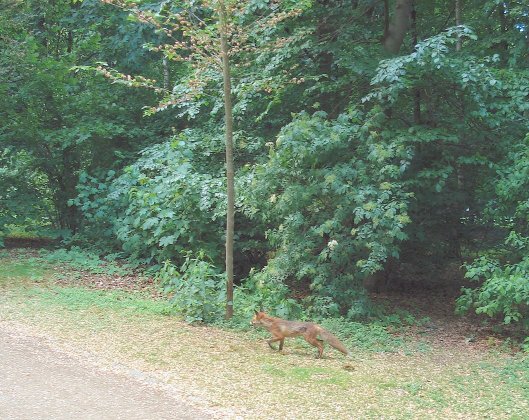 Just to show that the park
retains some of its hunting characteristics,
a red fox sauntered out of the brush
and on to the trail in front of
us. A
Just to show that the park
retains some of its hunting characteristics,
a red fox sauntered out of the brush
and on to the trail in front of
us. A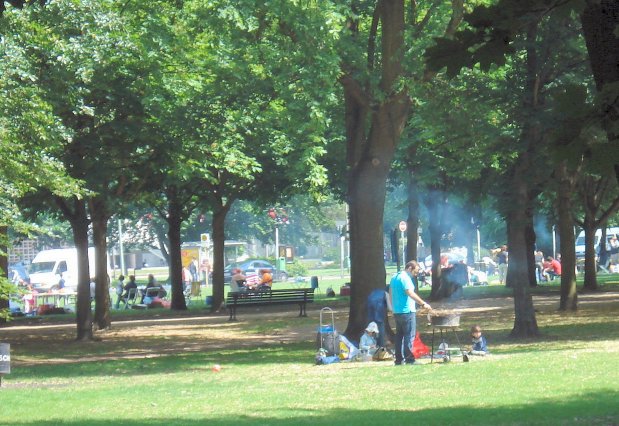 dog passing on the cross trail ahead of caught a whiff
of the fox
and began to bark excitedly while his owner hung on tight. The fox
quickly disappeared into the under story. We continued our survey of
the
Tiergarten and passed large open areas where the favorite park pastime
of "grilling" was in full swing on
this Sunday afternoon. Not far from
the Siegessaeule, we
dog passing on the cross trail ahead of caught a whiff
of the fox
and began to bark excitedly while his owner hung on tight. The fox
quickly disappeared into the under story. We continued our survey of
the
Tiergarten and passed large open areas where the favorite park pastime
of "grilling" was in full swing on
this Sunday afternoon. Not far from
the Siegessaeule, we  passed the Schloss
Bellevue. The magnificent
palace is situated beside the Spree River and it has been the principal
residence of the German President since 1994. Its name derives from its
beautiful view over the Spree. Bellevue was built in 1786 for Prince
Ferdinand of Prussia, the younger brother of King Frederick II of
Prussia. It was designed by architect Philipp Daniel Boumann as a
summer residence.
passed the Schloss
Bellevue. The magnificent
palace is situated beside the Spree River and it has been the principal
residence of the German President since 1994. Its name derives from its
beautiful view over the Spree. Bellevue was built in 1786 for Prince
Ferdinand of Prussia, the younger brother of King Frederick II of
Prussia. It was designed by architect Philipp Daniel Boumann as a
summer residence.

As we walked back across the Strasse des 17. Juni, we stopped to see the Soviet War Memorial, built in 1945, the only major structure on the course of the street between the Brandenburg Gate and the Siegessaeule. If nothing else, this memorial to the Russian soldiers who died in the quest for Berlin is massive. The twins tanks that flank the entry might even be considered somewhat gaudy.
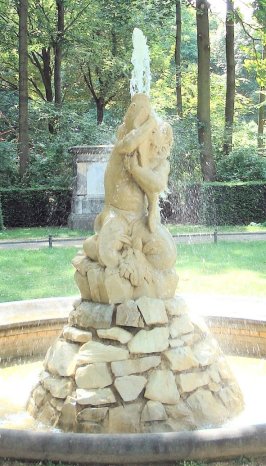 Various
other types of statues and monuments are found closer to the
eastern end of the park. A big fish
sculpture looks quite modern, and
it
Various
other types of statues and monuments are found closer to the
eastern end of the park. A big fish
sculpture looks quite modern, and
it is certainly whimsical. A statue of Frederick Wilhelm III overlooks
a pretty and pleasant flower garten, while the very modern Global Stone
Project has several intriguing features. More conventional
monuments
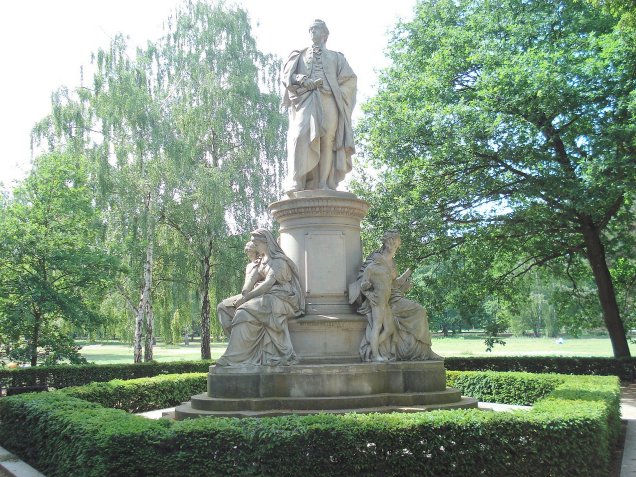
are dedicated to Goethe and another
is a triple memorial to musicians
Mozart, Bach and Hayden. A rather
bleak memorial to homosexuals
persecuted by the Nazis is a single gray block that looks like it
somehow got lost from the Holocaust Memorial across the street.
is certainly whimsical. A statue of Frederick Wilhelm III overlooks
a pretty and pleasant flower garten, while the very modern Global Stone
Project has several intriguing features. More conventional
monuments
are dedicated to Goethe and another
is a triple memorial to musicians
Mozart, Bach and Hayden. A rather
bleak memorial to homosexuals
persecuted by the Nazis is a single gray block that looks like it
somehow got lost from the Holocaust Memorial across the street.



 About 3 pm, we made a tour of Potsdamer Platz, one of the big new
developments that have been built where the wall and its no man's land
About 3 pm, we made a tour of Potsdamer Platz, one of the big new
developments that have been built where the wall and its no man's land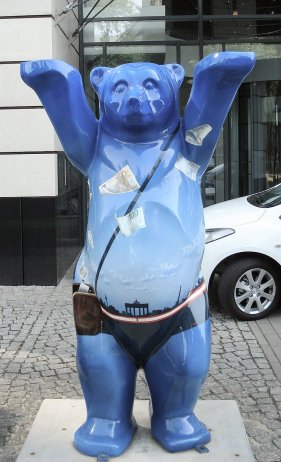 stood. The SONY Center is an architectural marvel of high rise
buildings and a huge interior covered courtyard. A large plastic Berlin
Bear -- in electric blue and not unlike the cows that can be found
in
Houston -- graced the foyer of one of the new buildings. The life sized
giraffe of Legoland also turned a
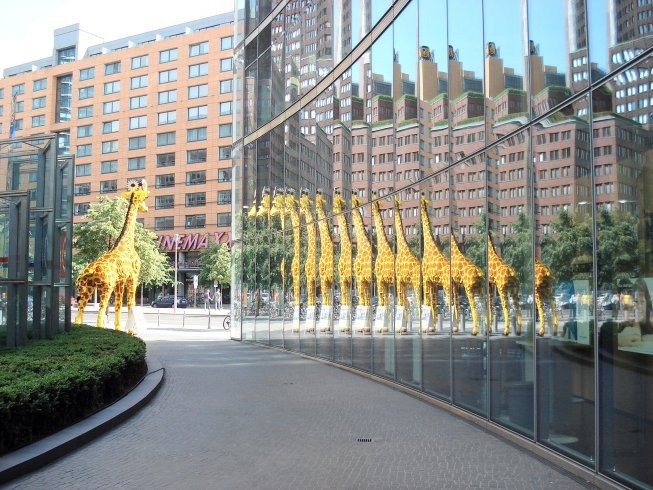
lot of heads.
stood. The SONY Center is an architectural marvel of high rise
buildings and a huge interior covered courtyard. A large plastic Berlin
Bear -- in electric blue and not unlike the cows that can be found
in
Houston -- graced the foyer of one of the new buildings. The life sized
giraffe of Legoland also turned a
lot of heads.
 After a long day of walking, we were beat.
Fortunately, the brand new
Potsdamer Platz Station was right
there, and
we jumped on the S-Bahn train for home -- 20 minutes!! Back in
Prenzlauer Berg, Matthew treated to Kaffee und Kuchen at a local bakery
shop
with a few tables situated on the sidewalk, and I had my first
Cappuccino with a
sweet roll. That night, we met Christian at the Prater
Biergarten. The Prater was built in 1837 on the hill far
outside the city walls. Today, it is in the Prenzlauer Berg district
where Matthew lives, and is only about a 5 minute walk from my hostel.
We had a good meal and some great conversation, but it turned out to be
a late night. I slept well.
After a long day of walking, we were beat.
Fortunately, the brand new
Potsdamer Platz Station was right
there, and
we jumped on the S-Bahn train for home -- 20 minutes!! Back in
Prenzlauer Berg, Matthew treated to Kaffee und Kuchen at a local bakery
shop
with a few tables situated on the sidewalk, and I had my first
Cappuccino with a
sweet roll. That night, we met Christian at the Prater
Biergarten. The Prater was built in 1837 on the hill far
outside the city walls. Today, it is in the Prenzlauer Berg district
where Matthew lives, and is only about a 5 minute walk from my hostel.
We had a good meal and some great conversation, but it turned out to be
a late night. I slept well.
Monday
 We had a little rain this morning, so I made it my
museum day.
Matthew had class all day, but he had showed me enough of how the
trains work and where to go in the downtown area that I felt
comfortable going by myself. The museums open at 10:00 am and the
streets were
We had a little rain this morning, so I made it my
museum day.
Matthew had class all day, but he had showed me enough of how the
trains work and where to go in the downtown area that I felt
comfortable going by myself. The museums open at 10:00 am and the
streets were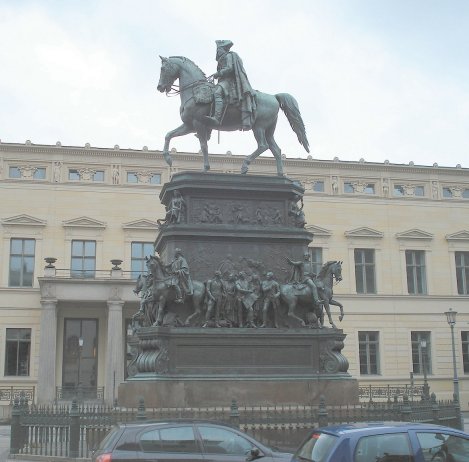 damp from an early shower. There
was no rain, however, as I walked to the museum district from the train
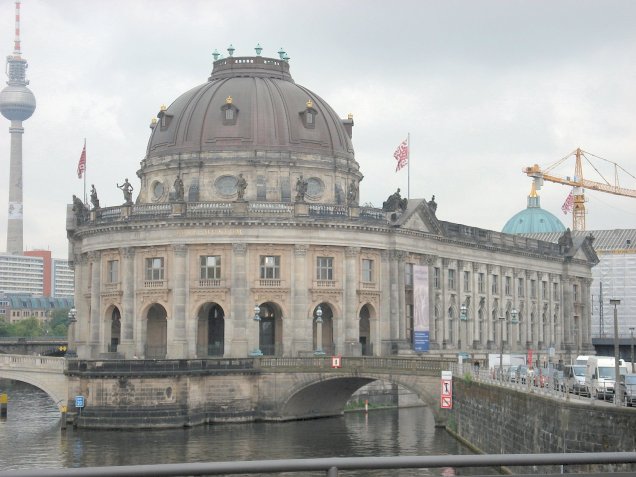
station. Passing the Bode Museum and
walking down the side street
called Universitaets Strasse, I mingled with students heading to class
at
damp from an early shower. There
was no rain, however, as I walked to the museum district from the train
station. Passing the Bode Museum and
walking down the side street
called Universitaets Strasse, I mingled with students heading to class
at  Humboldt University before I came to the
"old Fritz" statue of
Frederick the Great at the Unter
den Linden avenue. One of the
university buildings proudly displayed a bronze
plaque on the wall by
the sidewalk, proclaiming that "Max Planck taught here." Unless you are
into physics and Planck's constant, you may not appreciate that Planck
was one of the superstars of elementary particle research.
Humboldt University before I came to the
"old Fritz" statue of
Frederick the Great at the Unter
den Linden avenue. One of the
university buildings proudly displayed a bronze
plaque on the wall by
the sidewalk, proclaiming that "Max Planck taught here." Unless you are
into physics and Planck's constant, you may not appreciate that Planck
was one of the superstars of elementary particle research.
 The Bebelplatz that we had been to a few days earlier
lies across the
street from Humboldt University,
and this day permitted me a different
The Bebelplatz that we had been to a few days earlier
lies across the
street from Humboldt University,
and this day permitted me a different view of the plaza. In the far corner of Bebelplatz is the Catholic
Cathedral of St. Hedwig, a strangely shaped building, much less a
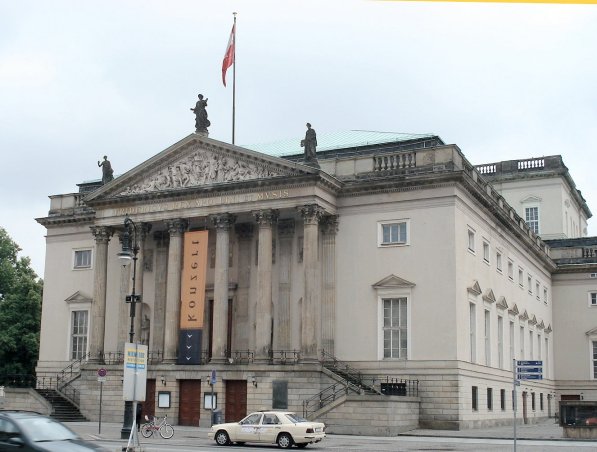
church. The east side of the plaza is bounded by the Stadts Oper (State
Opera House).
view of the plaza. In the far corner of Bebelplatz is the Catholic
Cathedral of St. Hedwig, a strangely shaped building, much less a
church. The east side of the plaza is bounded by the Stadts Oper (State
Opera House).
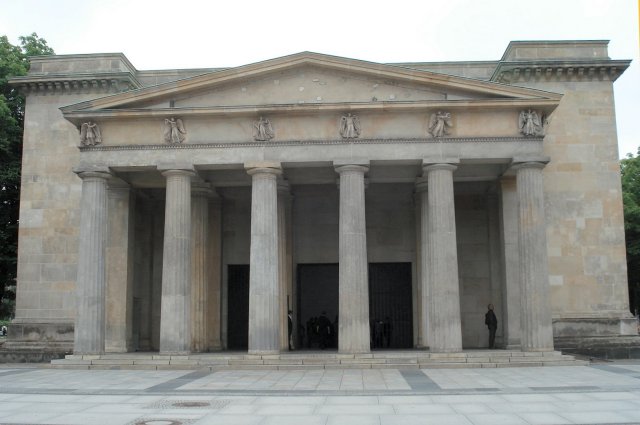 Next to the Humboldt is the Neue Wache (the New Guard House), built
in
1816 to house the emperor's guard. Designed after the Pantheon
Next to the Humboldt is the Neue Wache (the New Guard House), built
in
1816 to house the emperor's guard. Designed after the Pantheon in Rome,
the Neue Wache became a national memorial for victims of war and
tyranny after the fall of the Berlin
Wall. In the center of the otherwise empty square room of the building
is a replica of the Kaethe Kollwitz
sculpture entitled Mother with
Her Dead Son. If you
can manage it, wait for the waves of tourists to leave and stand in the
interior as the light from the oculus alone provides light to the
solemn scene.
in Rome,
the Neue Wache became a national memorial for victims of war and
tyranny after the fall of the Berlin
Wall. In the center of the otherwise empty square room of the building
is a replica of the Kaethe Kollwitz
sculpture entitled Mother with
Her Dead Son. If you
can manage it, wait for the waves of tourists to leave and stand in the
interior as the light from the oculus alone provides light to the
solemn scene.
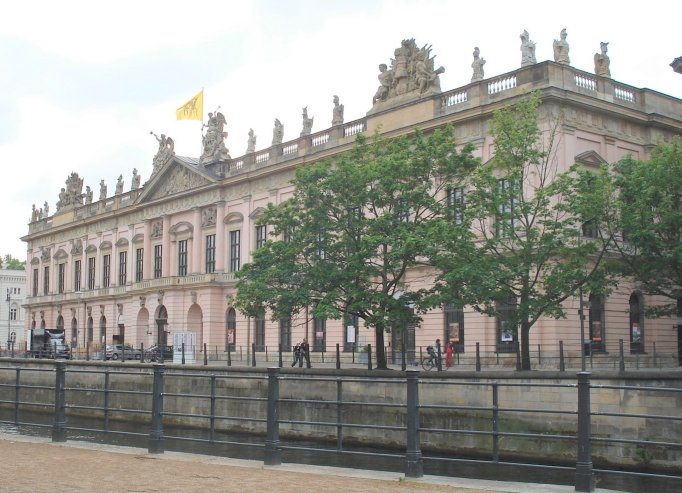 I then went over to the Deutsches Historisches Museum
(German History
Museum) which is next door. Housed in the former Zeughaus (arsenal),
this museum tells the complete story of the German people. I spent 3
hours there. I could have stayed longer, but my head
cannot absorb so much at one time. It is an absolutely fabulous museum
with a well organized and consistent story, supplemented with most
extraordinary collection of artifacts, documents and maps. It is,
without a doubt, the best museum I have ever been in.
I then went over to the Deutsches Historisches Museum
(German History
Museum) which is next door. Housed in the former Zeughaus (arsenal),
this museum tells the complete story of the German people. I spent 3
hours there. I could have stayed longer, but my head
cannot absorb so much at one time. It is an absolutely fabulous museum
with a well organized and consistent story, supplemented with most
extraordinary collection of artifacts, documents and maps. It is,
without a doubt, the best museum I have ever been in.
 Some of the more interesting artifacts to
me were the Meissen
porcelains from the 18th century, including a tea set and an ornamental
set of
Some of the more interesting artifacts to
me were the Meissen
porcelains from the 18th century, including a tea set and an ornamental
set of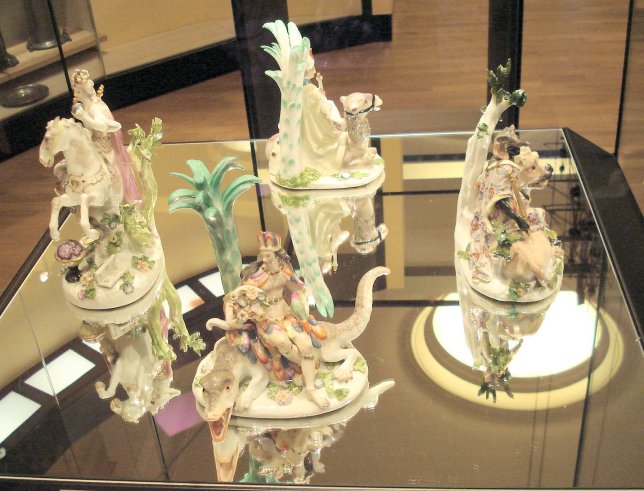 the Four Continents
with the highly unusual representation of
the continent of America. A painting from the Napoleonic period reminds
us that Wellington was almost doomed to defeat at Waterloo until
Marshal Bluecher arrived with his cavalry
the Four Continents
with the highly unusual representation of
the continent of America. A painting from the Napoleonic period reminds
us that Wellington was almost doomed to defeat at Waterloo until
Marshal Bluecher arrived with his cavalry  to save the day. In the
1870's, the emperor re-instituted the military decoration for valor,
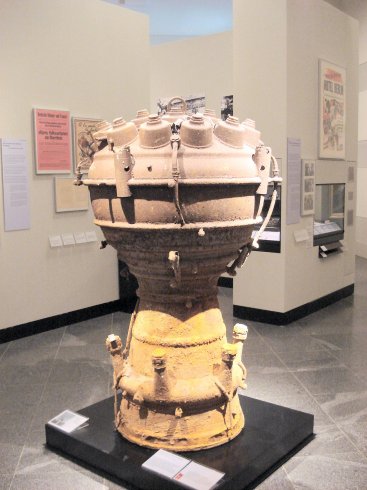
the Iron Cross. The World War II
exhibit has an actual combustion
chamber from a V2 Rocket -- the
predecessor to Werner von Braun's
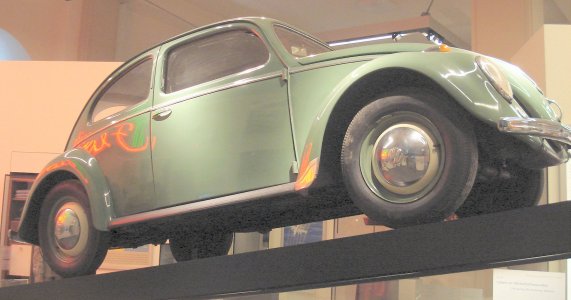
rocket science that put a man on the moon. The Cold War section
highlights the success of the West German recovery with a Volkswagen
Beetle -- which is green just like the one I myself owned in 1966!
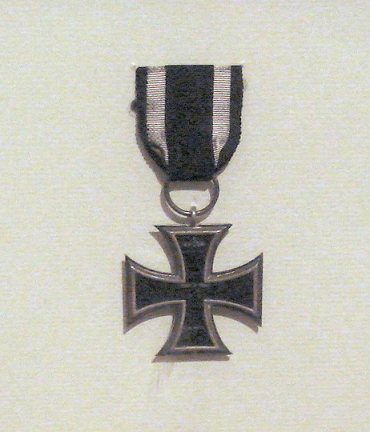
to save the day. In the
1870's, the emperor re-instituted the military decoration for valor,
the Iron Cross. The World War II
exhibit has an actual combustion
chamber from a V2 Rocket -- the
predecessor to Werner von Braun's
rocket science that put a man on the moon. The Cold War section
highlights the success of the West German recovery with a Volkswagen
Beetle -- which is green just like the one I myself owned in 1966!
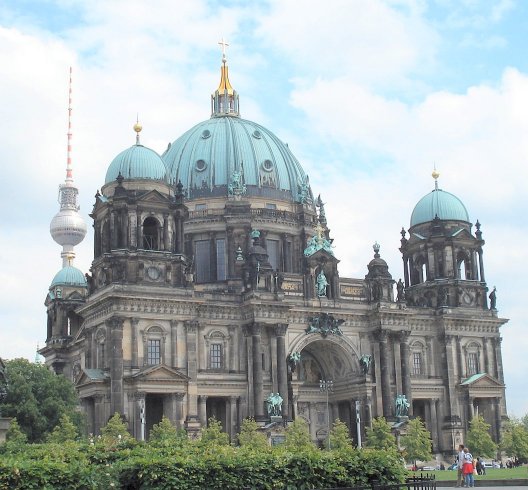 I ate lunch along the river in front of the park that
faces the
Berliner Dom. Then, I walked over to
the Pergamon Museum for the next
2-1/2
I ate lunch along the river in front of the park that
faces the
Berliner Dom. Then, I walked over to
the Pergamon Museum for the next
2-1/2 hours. They have some amazing stuff in that museum.
Whole
structures seemed to have been hauled back, eg, the Pergamon Altar, the
Ishtar Gates and the Market Gate of Miletus, and displayed in the most
realistic and remarkable way. Many statues of
Greek and Roman gods make this quite a fine collection of one of a kind
antiquities. The statue of the Boy with
a Thorn is a classic. This one
is a 2nd century AD Roman copy of a Greek original. The mosaic from the
Via Aurelia near Rome demonstrates
hours. They have some amazing stuff in that museum.
Whole
structures seemed to have been hauled back, eg, the Pergamon Altar, the
Ishtar Gates and the Market Gate of Miletus, and displayed in the most
realistic and remarkable way. Many statues of
Greek and Roman gods make this quite a fine collection of one of a kind
antiquities. The statue of the Boy with
a Thorn is a classic. This one
is a 2nd century AD Roman copy of a Greek original. The mosaic from the
Via Aurelia near Rome demonstrates  the Roman art at it finest. A small
statue of Zeus has solved a personal
mystery. I had seen numerous
depictions of Zeus or
the Roman art at it finest. A small
statue of Zeus has solved a personal
mystery. I had seen numerous
depictions of Zeus or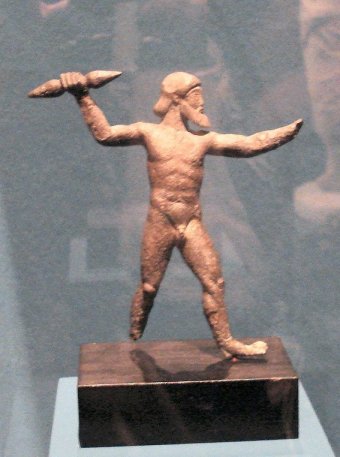 Jupiter hurling a two pointed cylindrical
object.
According to the Pergamon Museum exhibit, that object is his
thunderbolt!
Jupiter hurling a two pointed cylindrical
object.
According to the Pergamon Museum exhibit, that object is his
thunderbolt!
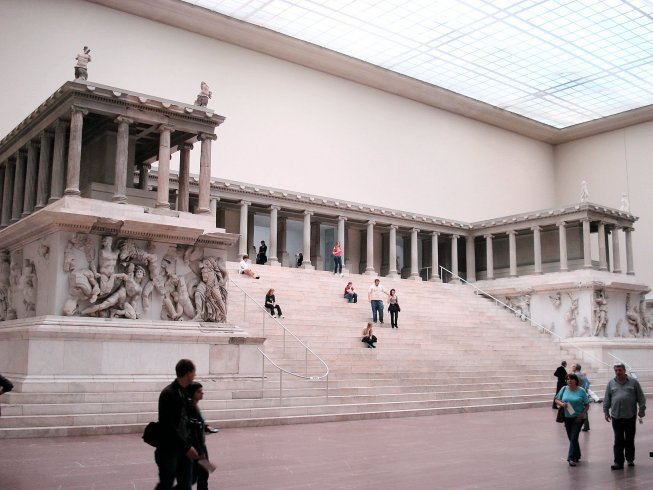 The Great Altar of
Pergamon, a massive stone podium about one hundred
feet long and thirty-five feet high, was originally built in the 2nd
century BCE in the Ancient Greek city of Pergamon (modern day Bergama
in Turkey) in north-western Anatolia. The main excavation was carried
out in two campaigns, in 1879 and 1904, and shipped out of the Ottoman
Empire by the German archaeological team led by Carl Humann. The
Pergamon Altar was reconstructed about 1910 in a museum that was built
in part to receive it. The current Pergamon Museum was built in 1930.
The Great Altar of
Pergamon, a massive stone podium about one hundred
feet long and thirty-five feet high, was originally built in the 2nd
century BCE in the Ancient Greek city of Pergamon (modern day Bergama
in Turkey) in north-western Anatolia. The main excavation was carried
out in two campaigns, in 1879 and 1904, and shipped out of the Ottoman
Empire by the German archaeological team led by Carl Humann. The
Pergamon Altar was reconstructed about 1910 in a museum that was built
in part to receive it. The current Pergamon Museum was built in 1930.
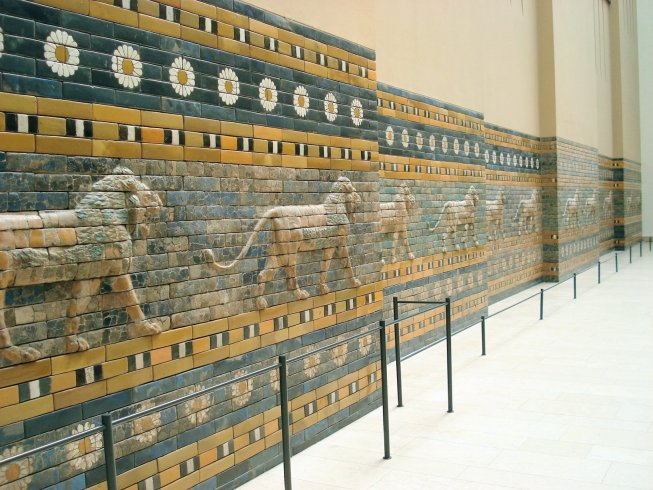
 The Ishtar Gate was
the eighth gate to the inner city of Babylon.
Constructed about 575 BC by order of King Nebuchadnezzar II on the
north
The Ishtar Gate was
the eighth gate to the inner city of Babylon.
Constructed about 575 BC by order of King Nebuchadnezzar II on the
north side of the city, the gate was dedicated
to the Babylonian
goddess Ishtar. The Gate was constructed of blue glazed tiles with
alternating rows of bas-relief sirrush
(dragons) and aurochs. The
auroch (Bos primigenius) was a type of wild cattle, the ancestor of
domestic cattle. The sirrush is a legendary creature that resembles a
scaly dragon with hind legs like an eagle's talons and feline forelegs.
It also has a long neck and tail, a horned head, a snakelike tongue and
a crest. The name "sirrush" is derived from an Akkadian word loosely
translated "splendor serpent." Lions line the walls of the great
hallway and other extensive wall panels from Babylon include the
march
of the warriors.
side of the city, the gate was dedicated
to the Babylonian
goddess Ishtar. The Gate was constructed of blue glazed tiles with
alternating rows of bas-relief sirrush
(dragons) and aurochs. The
auroch (Bos primigenius) was a type of wild cattle, the ancestor of
domestic cattle. The sirrush is a legendary creature that resembles a
scaly dragon with hind legs like an eagle's talons and feline forelegs.
It also has a long neck and tail, a horned head, a snakelike tongue and
a crest. The name "sirrush" is derived from an Akkadian word loosely
translated "splendor serpent." Lions line the walls of the great
hallway and other extensive wall panels from Babylon include the
march
of the warriors.

 Miletus was an ancient city on
the western coast of Anatolia (in
Turkey), near the mouth of the Maeander River. One remarkable artifact
Miletus was an ancient city on
the western coast of Anatolia (in
Turkey), near the mouth of the Maeander River. One remarkable artifact recovered from the city during the first excavations of the 19th
century was the Market Gate of Miletus.
The enormous structure was
transported piece by piece to Germany and reassembled at the Pergamon
Museum. A large mosaic has also
been reassembled from Miletus.
recovered from the city during the first excavations of the 19th
century was the Market Gate of Miletus.
The enormous structure was
transported piece by piece to Germany and reassembled at the Pergamon
Museum. A large mosaic has also
been reassembled from Miletus.
The whole day was spent absorbing as much as possible from these museums, and that really exhausted me. I picked up some fruit, yogurt, bread, cheese and snacks and ate a quiet dinner in my room. The forecast is for sunny weather tomorrow and the rest of the week. So, I am going to Potsdam tomorrow. Matthew said he will meet me after his morning classes.
Tuesday
Another big day in Berlin. Actually, in Potsdam, 25 miles southwest of Prenzlauer Berg, the neighborhood where I am staying. I did get an early start, hitting the S-Bahn station about 8:15 am. I rode the rush hour special (it was pretty crowded) to the Westkreuz (West Crossing) station where I got on the train heading southwest. Potsdam which is the last stop on the line. Got there about 9:20 am.
 I was not expecting Potsdam to be such a
big town. But, it is the
capital of the state of Brandenburg, so it is a place of some
importance. Although I had a small map, it took me a while to get
oriented. Matthew had classes this morning, but told me he would meet
me at "the big bridge." Now, I just had to figure out where that bridge
was. Only one wrong turn, but I circled back and went across the bridge
(called the Lange Bruecke) into the old town. The old town square lies
at the end of the bridge. The St.
Nikolai Kirche is wrapped in
scaffoding while the being renovated along with the other buildings on
the old square.
I was not expecting Potsdam to be such a
big town. But, it is the
capital of the state of Brandenburg, so it is a place of some
importance. Although I had a small map, it took me a while to get
oriented. Matthew had classes this morning, but told me he would meet
me at "the big bridge." Now, I just had to figure out where that bridge
was. Only one wrong turn, but I circled back and went across the bridge
(called the Lange Bruecke) into the old town. The old town square lies
at the end of the bridge. The St.
Nikolai Kirche is wrapped in
scaffoding while the being renovated along with the other buildings on
the old square.
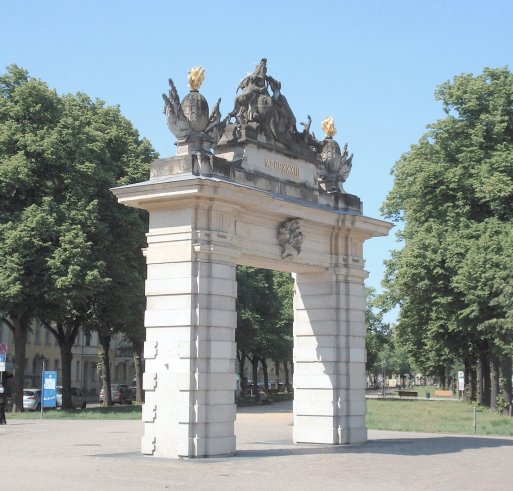
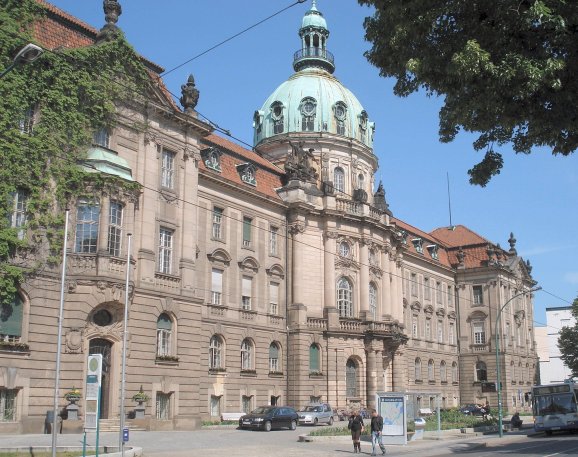 I
hiked up the main road
looking for the information office, but I missed it. After I passed the
Rathaus and came to a main highway,
I turned around and went back. I
found a city map posted by a bus stop, and oriented myself. Then, I
began to click off a few sites: the Jaeger
Gate, the Dutch
Quarter, the New Gate. On my way back,
I found a city information
office in the mall that houses the main post office.
I
hiked up the main road
looking for the information office, but I missed it. After I passed the
Rathaus and came to a main highway,
I turned around and went back. I
found a city map posted by a bus stop, and oriented myself. Then, I
began to click off a few sites: the Jaeger
Gate, the Dutch
Quarter, the New Gate. On my way back,
I found a city information
office in the mall that houses the main post office.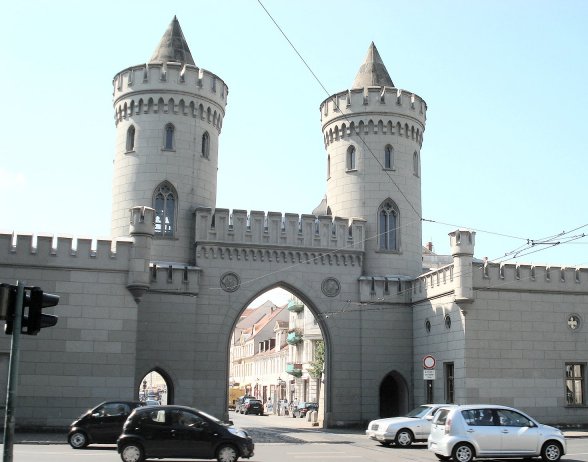
 The Platz der Einheit (Unity Square), opposite the post
office,
contains two memorials. Located at the edge of the park opposite the
post
The Platz der Einheit (Unity Square), opposite the post
office,
contains two memorials. Located at the edge of the park opposite the
post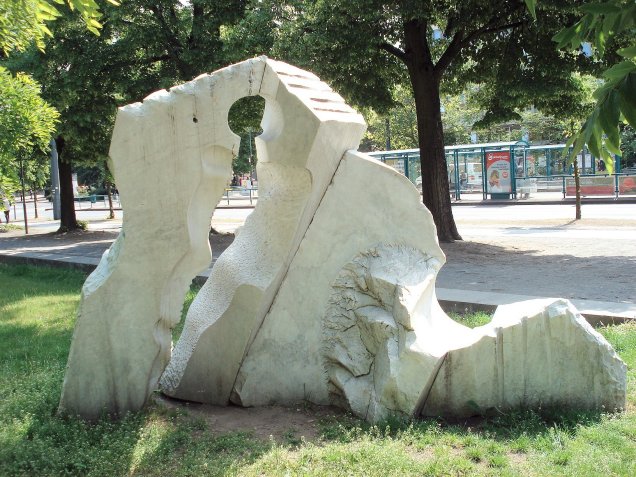 office is the memorial for the victims of fascism, which was
inaugurated on May 9, 1975. At the intersection of Strasse Am Kanal and
Friedrich-Ebert-Straße stands the Memorial for the Unknown
Deserter, designed by the Turkish sculptor Mehmet Aksoy (born
1939).
The attempt to place the artwork in Bonn in 1989, the city for which it
was created, failed because of the considerable resistance of
conservative groups. In August, 1990, the city council decided to set
up the memorial here in Potsdam, Bonn's sister city. The memorial which
celebrates those who refused to fight in WWII was included in the
re-design of the Platz der Einheit Square in 1999.
office is the memorial for the victims of fascism, which was
inaugurated on May 9, 1975. At the intersection of Strasse Am Kanal and
Friedrich-Ebert-Straße stands the Memorial for the Unknown
Deserter, designed by the Turkish sculptor Mehmet Aksoy (born
1939).
The attempt to place the artwork in Bonn in 1989, the city for which it
was created, failed because of the considerable resistance of
conservative groups. In August, 1990, the city council decided to set
up the memorial here in Potsdam, Bonn's sister city. The memorial which
celebrates those who refused to fight in WWII was included in the
re-design of the Platz der Einheit Square in 1999.
 I circled back toward the Lange Bruecke so
I
could be there at 12:30 as we agreed. On the way, I went into the big
Catholic
I circled back toward the Lange Bruecke so
I
could be there at 12:30 as we agreed. On the way, I went into the big
Catholic Church, Sts. Peter and Paul. Nicely done interior. All freshly
painted and renovated in 2005. The statue of Mary with a dagger
piercing heart takes the cake for stark realism with a religious motif.
Church, Sts. Peter and Paul. Nicely done interior. All freshly
painted and renovated in 2005. The statue of Mary with a dagger
piercing heart takes the cake for stark realism with a religious motif.
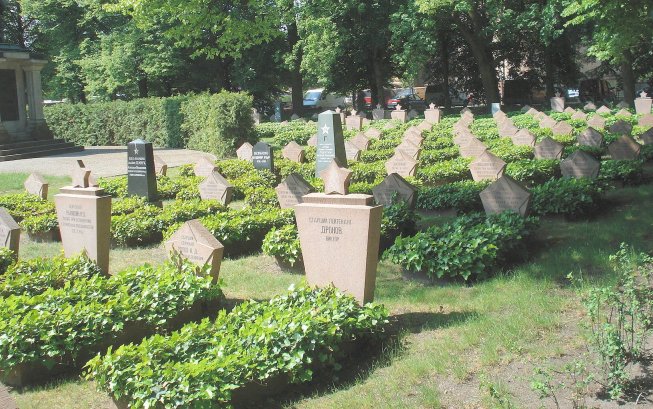 Behind the Catholic Church was a cemetery, so you can
imagine my
surprise when I went there and found that it was a cemetery and a
Behind the Catholic Church was a cemetery, so you can
imagine my
surprise when I went there and found that it was a cemetery and a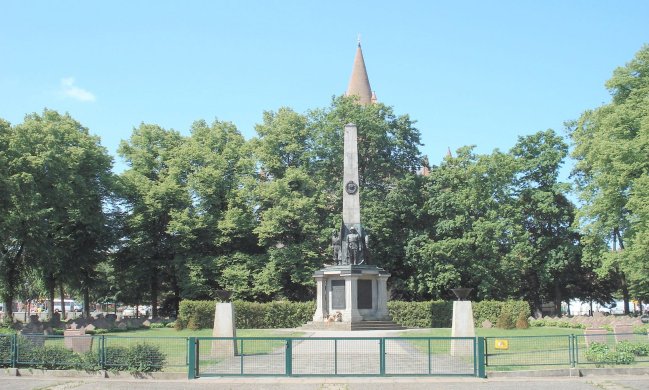 memorial to Soviet troops who died
during the taking of Berlin. No
sings, no interpretive displays, everything in Russian. A nice park
surrounds the cemetery and church and tourist bus parking lot (next
door). In this park was something to warm
memorial to Soviet troops who died
during the taking of Berlin. No
sings, no interpretive displays, everything in Russian. A nice park
surrounds the cemetery and church and tourist bus parking lot (next
door). In this park was something to warm 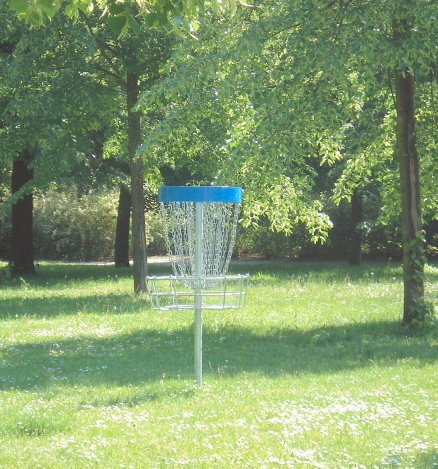 Stephen's heart -- a disc
golf course. I took a picture for proof!
Stephen's heart -- a disc
golf course. I took a picture for proof!

On the far corner of the park and across the street was the French Church, a protestant church build round like the Pantheon in Rome with a columned entrance, etc. Very small scale, though, and very plain inside.
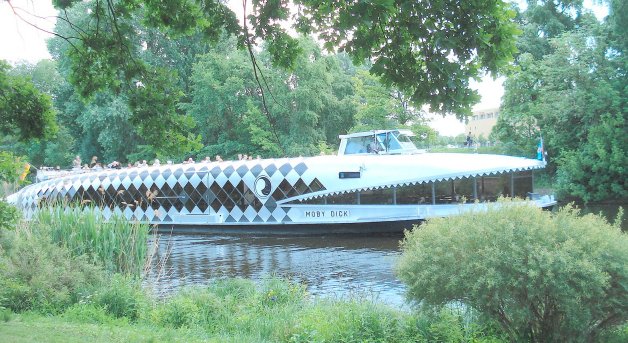 Finally, I made my way back to the bridge and waited
for Matthew, who
came along in about ten minutes. We went down to a park accessible from
the bridge since it is on an island in the river. It is the Friendship
Park and consists of gardens and playgrounds. We sat on a bench in the
shade near the children's playground and ate our lunch. A "theme" boat,
named the Moby Dick, cruised up the
river and was quite a site. Painted
to look like a whale (or perhaps, more like a shark), it even had an
extension at the rear like a tail.
Finally, I made my way back to the bridge and waited
for Matthew, who
came along in about ten minutes. We went down to a park accessible from
the bridge since it is on an island in the river. It is the Friendship
Park and consists of gardens and playgrounds. We sat on a bench in the
shade near the children's playground and ate our lunch. A "theme" boat,
named the Moby Dick, cruised up the
river and was quite a site. Painted
to look like a whale (or perhaps, more like a shark), it even had an
extension at the rear like a tail.
 After lunch we walked back up to the French Church, the
Soviet Cemetery
and the Catholic Church so Matthew could see them. Our main
After lunch we walked back up to the French Church, the
Soviet Cemetery
and the Catholic Church so Matthew could see them. Our main goal for
the day was the Sans Souci Park where the royal palaces of Frederick
the Great and other rulers are. To get there, we walked down
Brandenburger Strasse directly from the Catholic Church to the
Brandenburg Gate (yes, they
have one here, too), and then into the
Park. We proceeded into the grounds along a small, tree-lined street
called Allee Nach Sanssouci.
goal for
the day was the Sans Souci Park where the royal palaces of Frederick
the Great and other rulers are. To get there, we walked down
Brandenburger Strasse directly from the Catholic Church to the
Brandenburg Gate (yes, they
have one here, too), and then into the
Park. We proceeded into the grounds along a small, tree-lined street
called Allee Nach Sanssouci.
 As this
street ended in a "T", we turned
north onto the entry to the main palace
grounds. The Park is a huge
wooded estate approximately 2
As this
street ended in a "T", we turned
north onto the entry to the main palace
grounds. The Park is a huge
wooded estate approximately 2 
 km across. The great palace of Sans Souci
is the first that you come to. It sits
high on a terraced hill with statues and fountains all around. To the
east side of the upper courtyard is the burial
plot of Frederick the
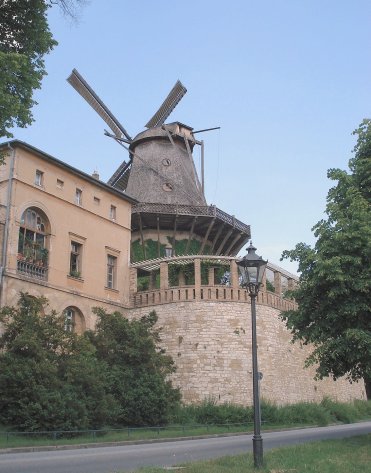
Great, and his 11 dogs. In a move to make the palace self-sufficent, a
windmill was used to process the
agricultural products grown for the
estate. It still rot
km across. The great palace of Sans Souci
is the first that you come to. It sits
high on a terraced hill with statues and fountains all around. To the
east side of the upper courtyard is the burial
plot of Frederick the
Great, and his 11 dogs. In a move to make the palace self-sufficent, a
windmill was used to process the
agricultural products grown for the
estate. It still rot ates and towers over the palace complex.

 A
main road of gravel extends the length of the park from the obelisk
portal on the east end, past the Sans Souci palace, to the New Palace
on the west end -- 2 km away. We continued down the long, tree-lined
street to the New Palace, seeing
the Chinese House and the
magnificent Orangerie Palace on
the way back.
Various other buildings of the estate served the fancy of the royal
family. One of these is the Neue
Kammern, a gallery of fine art. Just
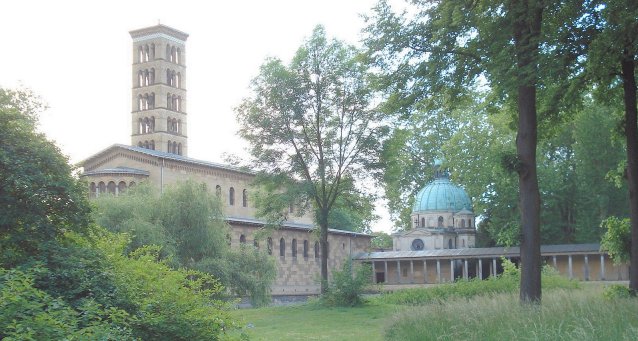
before exiting the Park, we came to the Frieden
Church.
A
main road of gravel extends the length of the park from the obelisk
portal on the east end, past the Sans Souci palace, to the New Palace
on the west end -- 2 km away. We continued down the long, tree-lined
street to the New Palace, seeing
the Chinese House and the
magnificent Orangerie Palace on
the way back.
Various other buildings of the estate served the fancy of the royal
family. One of these is the Neue
Kammern, a gallery of fine art. Just
before exiting the Park, we came to the Frieden
Church.


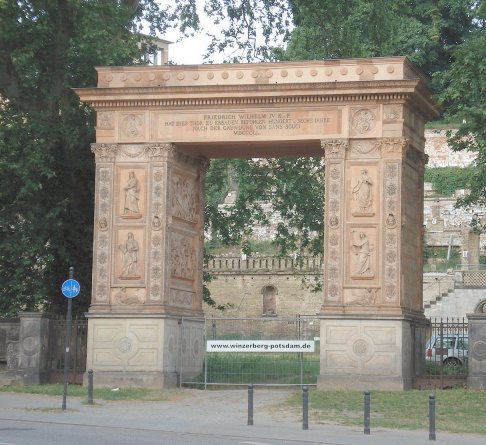 An oddity was found outside the park along the road.
The site was
established as a terraced wineyard on the hill (Winzerberg) for the
palace about 1763. The Triumphtor
(Triumph Gate) was commissioned by
Friedrich Wilhelm IV in 1848 and built according to plans by Friedrich
August Stueler. In ruins today because of the air raid tunnels built
into the mountain and subsequently destroyed by the Soviet army, it
seems forelorn and detached from the palace. It is one of those items
destroyed during the war and neglected by the DDR that are awaiting its
historical restoration.
An oddity was found outside the park along the road.
The site was
established as a terraced wineyard on the hill (Winzerberg) for the
palace about 1763. The Triumphtor
(Triumph Gate) was commissioned by
Friedrich Wilhelm IV in 1848 and built according to plans by Friedrich
August Stueler. In ruins today because of the air raid tunnels built
into the mountain and subsequently destroyed by the Soviet army, it
seems forelorn and detached from the palace. It is one of those items
destroyed during the war and neglected by the DDR that are awaiting its
historical restoration.
And with that, we headed back to the train station so Matthew could make his class at 6 pm. We did have time to stop along the way for an ice cream stop -- 2 kugels for 1.20 euro.
Potsdam is quite different than I expected, but, then what do I know anyway?
The weather has been great, though getting a bit warm -- mid-70's. They do NOT have AC here.
I did have an interesting experience on the train this morning. The ticket checkers came through the train on the way to Westkreuz. Not a problem for me, but a guy across the aisle got caught without a ticket. Then, on the train to Potsdam -- the same thing. And, the guy next to me got caught. I must be bad luck for them. These ticket checkers were very nice. They showed their BVG badges as they asked each person for their ticket. They were really dressed like no one special either. Quite a thing to witness. Trust, but verify.
Tomorrow, I have a light day planned. One thing I must do is re-pack my suitcase. I hope it all fits! Matthew has class until 4 pm. We will go to dinner, then we'll get an early night's sleep since we have to be at the train station at 3 am to make my 6 am flight. That will be an adventure! It is hard to believe that the trip is almost over. I am really getting used to this place.
Wednesday
Just paid my bill, and guess what? They gave me a 10% discount for a long stay. These people (all young folks - I've met 4 of them) are very nice and very proficient. The guy who checked me out said his mother escaped from East Berlin, but now she hardly wants to come over here to visit. Since I am leaving very early in the morning, I asked the clerk if Matthew could drop off the key and get the 10 euro deposit. He said: "Heck no, here's your deposit, just leave the key in the room when you leave." What a place!
On this last day in Berlin, I planned only to explore the Prenzlauer Berg neighborhood a little. This is the neighborhood where I have been staying on this trip, and like most neighborhoods in any city, it has its own special places and interesting stories which are not important enough to make the tour guides, but which are a part of the history none the less. On this pleasant and sunny morning, I packed a lunch and headed up Pappelallee across the S-Bahn tracks to the next main street. Turning to the right, I passed the local Catholic Church and then came to the main street of the neighborhood, Prenzlauer Allee.
 This street definitely had the business activity of a
main route. Commercial buildings, stores and lots of vehicles. I walked
back south until I
This street definitely had the business activity of a
main route. Commercial buildings, stores and lots of vehicles. I walked
back south until I crossed the tracks again and came to the Zeiss-Grossplanetarium located on this
end of Ernst Thaelmann Park. The park was formerly the site of the gas works on Danziger Strasse. The gas
works burnt coal from the years 1873 until
1981 and was the oldest and
longest active gas works in Berlin. In 1984, the DDR decided that the
site should be a socialist park, with
crossed the tracks again and came to the Zeiss-Grossplanetarium located on this
end of Ernst Thaelmann Park. The park was formerly the site of the gas works on Danziger Strasse. The gas
works burnt coal from the years 1873 until
1981 and was the oldest and
longest active gas works in Berlin. In 1984, the DDR decided that the
site should be a socialist park, with decorative high-rise
residential buildings, a cultural centre with restaurants and a
planetarium. The planetarium opened on October 9, 1987 during Berlin's
750th anniversary. The Zeiss-Grossplanetarium is one of
the largest and most modern planetariums in Europe, with a dome of 23
meters (75.5 feet). I walked through the park to its eastern side where
a monument to the park's namesake
makes a statement, one that seems a bit passe these days.
decorative high-rise
residential buildings, a cultural centre with restaurants and a
planetarium. The planetarium opened on October 9, 1987 during Berlin's
750th anniversary. The Zeiss-Grossplanetarium is one of
the largest and most modern planetariums in Europe, with a dome of 23
meters (75.5 feet). I walked through the park to its eastern side where
a monument to the park's namesake
makes a statement, one that seems a bit passe these days.
 Following a route through the neighborhood streets on
the way back to my hostel, I came to a water tower and a park with
playgrounds. The Wasserturm
Prenzlauer Berg is Berlin's oldest water tower, completed in 1877
and in use until 1952. The water works system for north Berlin, built
by English engineer Henry Gill in 1856, initially consisted of a
reservoir and a supply line tower on Windmuehlenberg (wind mill hill),
just north of the Prenzlauer Gate. Greater demand for water led to the
construction of the massive new water tower, nicknamed "Fat Hermann,"
in 1877 adjacent to the facilities on the hill. In January, 1933, the
Nazi SA-troops (Sturmabteilung,
storm troops) used the boiler and engine rooms of the tower as one of
the first concentration camps. Today, there is a memorial to the
anti-fascists who were tortured and murdered there. The water tower was
decommissioned in 1952, and playgrounds occupy much of the park built
on the site. Excellent views of Berlin can be had from the top of the
hill.
Following a route through the neighborhood streets on
the way back to my hostel, I came to a water tower and a park with
playgrounds. The Wasserturm
Prenzlauer Berg is Berlin's oldest water tower, completed in 1877
and in use until 1952. The water works system for north Berlin, built
by English engineer Henry Gill in 1856, initially consisted of a
reservoir and a supply line tower on Windmuehlenberg (wind mill hill),
just north of the Prenzlauer Gate. Greater demand for water led to the
construction of the massive new water tower, nicknamed "Fat Hermann,"
in 1877 adjacent to the facilities on the hill. In January, 1933, the
Nazi SA-troops (Sturmabteilung,
storm troops) used the boiler and engine rooms of the tower as one of
the first concentration camps. Today, there is a memorial to the
anti-fascists who were tortured and murdered there. The water tower was
decommissioned in 1952, and playgrounds occupy much of the park built
on the site. Excellent views of Berlin can be had from the top of the
hill.
 By now, I had made the circuit of this sie
of Prenzlauer Berg, so I headed back to my room to pack up for the trip
home. After his classes, Matthew and I met for a farewell dinner. By mutual agreement, we
decided to eat at one of the local Doener Kebab restaurants in the
area. These places are everywhere and serve braised lamb in a pita
bread with lettuce, tomatoes and onions. It seems that most of these
places are run by Turks, and they know how to do fast food! We went to
a kebab stand on Schoenhauser Allee near the Arcaden. Matthew had the
combo meal of Doener Kebab, fries and a coke. I had a kebab and a beer.
All for 8.40 euros.
By now, I had made the circuit of this sie
of Prenzlauer Berg, so I headed back to my room to pack up for the trip
home. After his classes, Matthew and I met for a farewell dinner. By mutual agreement, we
decided to eat at one of the local Doener Kebab restaurants in the
area. These places are everywhere and serve braised lamb in a pita
bread with lettuce, tomatoes and onions. It seems that most of these
places are run by Turks, and they know how to do fast food! We went to
a kebab stand on Schoenhauser Allee near the Arcaden. Matthew had the
combo meal of Doener Kebab, fries and a coke. I had a kebab and a beer.
All for 8.40 euros.
After the meal, we walked around the neighborhood in order to make room for a final ice cream cone at the local EisZeit shop.
Thursday
Woke up using my internet alarm clock program at 2:00 am. I met Matthew at his place at 2:30 and we began the early morning transit system ride to Tegel Airport for my 6:05 am flight back to the US. Smooth and efficient, even the Acsension Day holiday schedule pf the BVG went off like clockwork. It just took a little longer than the regular day time route. Soon, I was checked in at KLM and on the sunrise flight to Amsterdam and the connecting flight to IAH and Texas.
<< Go to Page One
All material printed on
this
page
and this web site is copyrighted. All rights reserved.Sunday
A big day today! Matthew and I rode the train downtown and began a hike on the west side of the large City Park called the Tiergarten. First, thou
gh, we saw the ruins of the Kaiser Wilhelm Memorial Church --
unrestored large part of a grand "king's" church. The church was built
by Kaiser Wilhelm II and its title was given in honor of his
grandfather Kaiser Wilhelm I. The foundation stone was laid on March
22, 1891, Wilhelm I's birthday. Designed by Franz Schwechten, who
planned a large church in neo-Romanesque style, the church was
consecrated on September 1, 1895, but the entrance hall in the lower
section had not been completed. It was opened and consecrated on
February 22, 1906. The church was badly damaged in an air raid on the
night of November 23, 1943. The ruins have been left standing as a
memorial to the destruction of Berlin during WWII. A new tower stands
side by side with the ruins. A plaque on the ruin shows how the
original church looked.Then, we walked by
the Zoo. Located on the southwest side of the Tiergarten, entrance to
the Zoo is made through the famous elephant gate. We walked along the
side of the Zoo and were able to catch glimpses of some of the animals
including llamas and an ostrich, among other exotic animals. That
brought us to the edge of the Tiergarten at a place where the Spanish
Embassy is.The Tiergarten (which means the animal garden) was once a hunting ground of the Electors of Brandenburg. It was designed in the 1830s by landscape
architect Peter Joseph Lenné, and at 630 acres,
the
Tiergarten is the city's largest park. I had plotted on my map all of
the 23 or so monuments in the park, and
our goal was to find each one. Some of these monuments date to the
early 1900's and are not well taken care of. The signage is extremely
poor, too. But, we zigzagged across the park, through the forested
trails, though the flower gardens and over bridges crossing the
canals
until we located all but two of the monuments and statues. We even
found a couple that had been added since the maps were printed. The
tree-lined walkways contain several ceremonial sculptures of Prussian
aristocrats partaking in an 18th century
hunt. Several notable
sculptures, including the four-tiered Siegessaeule, the Bismarck
Memorial and several other memorials to prominent Prussian
generals,
celebrate the prowess of the Prussian empire.Although the Tiergarten is now an appealing combination of dense forest and sunny meadows, it's woodland is post-WWII since the park was largely deforested after 1944. It's trees served as a source of firewood for the devastated city. You would scarcely believe that today. We ate a picnic lunch on a bench in a wooded section of a trail -- and, out of sight of the nude sunbathers!! Apparently, that is quite the thing here when the weather turns nice, and that it was -- warm and sunny, near 70 all day.
As we made our way east toward the Brandenburg gate, the city had blocked of the area of the main boulevard and the gate in order to set up a stage for the
60th anniversary of the German Democratic
government. The roadblock was at the circle where the Siegessaeule
stands, but we were able to get to the memorial through the tunnels
that go under the busy street. The Siegessaeule
(Victory Column),
designed by Heinrich Strack in 1864 to commemorate the Prussian victory
in the Danish-Prussian War. By the time it was inaugurated in
September, 1873, Prussia had also defeated Austria in the
Austro-Prussian War (1866) and France in the Franco-Prussian War
(1870–71). These later victories in the so-called unification
wars inspired the addition of the bronze sculpture of Victoria, which
stands 8.3 meters high and weighs 35 tons. The Siegessaeule originally
stood in Koenigsplatz (now Platz der Republik) in front of the
Reichstag. As part of the preparation of the monumental plans to
redesign Berlin in 1939, the Nazis relocated the column, and several
statues of Prussian generals, to its present site.Just to show that the park
retains some of its hunting characteristics,
a red fox sauntered out of the brush
and on to the trail in front of
us. A dog passing on the cross trail ahead of caught a whiff
of the fox
and began to bark excitedly while his owner hung on tight. The fox
quickly disappeared into the under story. We continued our survey of
the
Tiergarten and passed large open areas where the favorite park pastime
of "grilling" was in full swing on
this Sunday afternoon. Not far from
the Siegessaeule, we passed the Schloss
Bellevue. The magnificent
palace is situated beside the Spree River and it has been the principal
residence of the German President since 1994. Its name derives from its
beautiful view over the Spree. Bellevue was built in 1786 for Prince
Ferdinand of Prussia, the younger brother of King Frederick II of
Prussia. It was designed by architect Philipp Daniel Boumann as a
summer residence.As we walked back across the Strasse des 17. Juni, we stopped to see the Soviet War Memorial, built in 1945, the only major structure on the course of the street between the Brandenburg Gate and the Siegessaeule. If nothing else, this memorial to the Russian soldiers who died in the quest for Berlin is massive. The twins tanks that flank the entry might even be considered somewhat gaudy.
Various
other types of statues and monuments are found closer to the
eastern end of the park. A big fish
sculpture looks quite modern, and
it is certainly whimsical. A statue of Frederick Wilhelm III overlooks
a pretty and pleasant flower garten, while the very modern Global Stone
Project has several intriguing features. More conventional
monuments
are dedicated to Goethe and another
is a triple memorial to musicians
Mozart, Bach and Hayden. A rather
bleak memorial to homosexuals
persecuted by the Nazis is a single gray block that looks like it
somehow got lost from the Holocaust Memorial across the street.About 3 pm, we made a tour of Potsdamer Platz, one of the big new
developments that have been built where the wall and its no man's land
stood. The SONY Center is an architectural marvel of high rise
buildings and a huge interior covered courtyard. A large plastic Berlin
Bear -- in electric blue and not unlike the cows that can be found
in
Houston -- graced the foyer of one of the new buildings. The life sized
giraffe of Legoland also turned a
lot of heads.After a long day of walking, we were beat.
Fortunately, the brand new
Potsdamer Platz Station was right
there, and
we jumped on the S-Bahn train for home -- 20 minutes!! Back in
Prenzlauer Berg, Matthew treated to Kaffee und Kuchen at a local bakery
shop
with a few tables situated on the sidewalk, and I had my first
Cappuccino with a
sweet roll. That night, we met Christian at the Prater
Biergarten. The Prater was built in 1837 on the hill far
outside the city walls. Today, it is in the Prenzlauer Berg district
where Matthew lives, and is only about a 5 minute walk from my hostel.
We had a good meal and some great conversation, but it turned out to be
a late night. I slept well.Monday
We had a little rain this morning, so I made it my
museum day.
Matthew had class all day, but he had showed me enough of how the
trains work and where to go in the downtown area that I felt
comfortable going by myself. The museums open at 10:00 am and the
streets were damp from an early shower. There
was no rain, however, as I walked to the museum district from the train
station. Passing the Bode Museum and
walking down the side street
called Universitaets Strasse, I mingled with students heading to class
at Humboldt University before I came to the
"old Fritz" statue of
Frederick the Great at the Unter
den Linden avenue. One of the
university buildings proudly displayed a bronze
plaque on the wall by
the sidewalk, proclaiming that "Max Planck taught here." Unless you are
into physics and Planck's constant, you may not appreciate that Planck
was one of the superstars of elementary particle research. The Bebelplatz that we had been to a few days earlier
lies across the
street from Humboldt University,
and this day permitted me a different
view of the plaza. In the far corner of Bebelplatz is the Catholic
Cathedral of St. Hedwig, a strangely shaped building, much less a
church. The east side of the plaza is bounded by the Stadts Oper (State
Opera House).Next to the Humboldt is the Neue Wache (the New Guard House), built
in
1816 to house the emperor's guard. Designed after the Pantheon in Rome,
the Neue Wache became a national memorial for victims of war and
tyranny after the fall of the Berlin
Wall. In the center of the otherwise empty square room of the building
is a replica of the Kaethe Kollwitz
sculpture entitled Mother with
Her Dead Son. If you
can manage it, wait for the waves of tourists to leave and stand in the
interior as the light from the oculus alone provides light to the
solemn scene.I then went over to the Deutsches Historisches Museum
(German History
Museum) which is next door. Housed in the former Zeughaus (arsenal),
this museum tells the complete story of the German people. I spent 3
hours there. I could have stayed longer, but my head
cannot absorb so much at one time. It is an absolutely fabulous museum
with a well organized and consistent story, supplemented with most
extraordinary collection of artifacts, documents and maps. It is,
without a doubt, the best museum I have ever been in.Some of the more interesting artifacts to
me were the Meissen
porcelains from the 18th century, including a tea set and an ornamental
set of the Four Continents
with the highly unusual representation of
the continent of America. A painting from the Napoleonic period reminds
us that Wellington was almost doomed to defeat at Waterloo until
Marshal Bluecher arrived with his cavalry to save the day. In the
1870's, the emperor re-instituted the military decoration for valor,
the Iron Cross. The World War II
exhibit has an actual combustion
chamber from a V2 Rocket -- the
predecessor to Werner von Braun's
rocket science that put a man on the moon. The Cold War section
highlights the success of the West German recovery with a Volkswagen
Beetle -- which is green just like the one I myself owned in 1966!I ate lunch along the river in front of the park that
faces the
Berliner Dom. Then, I walked over to
the Pergamon Museum for the next
2-1/2 hours. They have some amazing stuff in that museum.
Whole
structures seemed to have been hauled back, eg, the Pergamon Altar, the
Ishtar Gates and the Market Gate of Miletus, and displayed in the most
realistic and remarkable way. Many statues of
Greek and Roman gods make this quite a fine collection of one of a kind
antiquities. The statue of the Boy with
a Thorn is a classic. This one
is a 2nd century AD Roman copy of a Greek original. The mosaic from the
Via Aurelia near Rome demonstrates the Roman art at it finest. A small
statue of Zeus has solved a personal
mystery. I had seen numerous
depictions of Zeus or Jupiter hurling a two pointed cylindrical
object.
According to the Pergamon Museum exhibit, that object is his
thunderbolt!The Great Altar of
Pergamon, a massive stone podium about one hundred
feet long and thirty-five feet high, was originally built in the 2nd
century BCE in the Ancient Greek city of Pergamon (modern day Bergama
in Turkey) in north-western Anatolia. The main excavation was carried
out in two campaigns, in 1879 and 1904, and shipped out of the Ottoman
Empire by the German archaeological team led by Carl Humann. The
Pergamon Altar was reconstructed about 1910 in a museum that was built
in part to receive it. The current Pergamon Museum was built in 1930.The Ishtar Gate was
the eighth gate to the inner city of Babylon.
Constructed about 575 BC by order of King Nebuchadnezzar II on the
north side of the city, the gate was dedicated
to the Babylonian
goddess Ishtar. The Gate was constructed of blue glazed tiles with
alternating rows of bas-relief sirrush
(dragons) and aurochs. The
auroch (Bos primigenius) was a type of wild cattle, the ancestor of
domestic cattle. The sirrush is a legendary creature that resembles a
scaly dragon with hind legs like an eagle's talons and feline forelegs.
It also has a long neck and tail, a horned head, a snakelike tongue and
a crest. The name "sirrush" is derived from an Akkadian word loosely
translated "splendor serpent." Lions line the walls of the great
hallway and other extensive wall panels from Babylon include the
march
of the warriors.Miletus was an ancient city on
the western coast of Anatolia (in
Turkey), near the mouth of the Maeander River. One remarkable artifact
recovered from the city during the first excavations of the 19th
century was the Market Gate of Miletus.
The enormous structure was
transported piece by piece to Germany and reassembled at the Pergamon
Museum. A large mosaic has also
been reassembled from Miletus.The whole day was spent absorbing as much as possible from these museums, and that really exhausted me. I picked up some fruit, yogurt, bread, cheese and snacks and ate a quiet dinner in my room. The forecast is for sunny weather tomorrow and the rest of the week. So, I am going to Potsdam tomorrow. Matthew said he will meet me after his morning classes.
Tuesday
Another big day in Berlin. Actually, in Potsdam, 25 miles southwest of Prenzlauer Berg, the neighborhood where I am staying. I did get an early start, hitting the S-Bahn station about 8:15 am. I rode the rush hour special (it was pretty crowded) to the Westkreuz (West Crossing) station where I got on the train heading southwest. Potsdam which is the last stop on the line. Got there about 9:20 am.
I was not expecting Potsdam to be such a
big town. But, it is the
capital of the state of Brandenburg, so it is a place of some
importance. Although I had a small map, it took me a while to get
oriented. Matthew had classes this morning, but told me he would meet
me at "the big bridge." Now, I just had to figure out where that bridge
was. Only one wrong turn, but I circled back and went across the bridge
(called the Lange Bruecke) into the old town. The old town square lies
at the end of the bridge. The St.
Nikolai Kirche is wrapped in
scaffoding while the being renovated along with the other buildings on
the old square.I
hiked up the main road
looking for the information office, but I missed it. After I passed the
Rathaus and came to a main highway,
I turned around and went back. I
found a city map posted by a bus stop, and oriented myself. Then, I
began to click off a few sites: the Jaeger
Gate, the Dutch
Quarter, the New Gate. On my way back,
I found a city information
office in the mall that houses the main post office.The Platz der Einheit (Unity Square), opposite the post
office,
contains two memorials. Located at the edge of the park opposite the
post office is the memorial for the victims of fascism, which was
inaugurated on May 9, 1975. At the intersection of Strasse Am Kanal and
Friedrich-Ebert-Straße stands the Memorial for the Unknown
Deserter, designed by the Turkish sculptor Mehmet Aksoy (born
1939).
The attempt to place the artwork in Bonn in 1989, the city for which it
was created, failed because of the considerable resistance of
conservative groups. In August, 1990, the city council decided to set
up the memorial here in Potsdam, Bonn's sister city. The memorial which
celebrates those who refused to fight in WWII was included in the
re-design of the Platz der Einheit Square in 1999. I circled back toward the Lange Bruecke so
I
could be there at 12:30 as we agreed. On the way, I went into the big
Catholic Church, Sts. Peter and Paul. Nicely done interior. All freshly
painted and renovated in 2005. The statue of Mary with a dagger
piercing heart takes the cake for stark realism with a religious motif.Behind the Catholic Church was a cemetery, so you can
imagine my
surprise when I went there and found that it was a cemetery and a
memorial to Soviet troops who died
during the taking of Berlin. No
sings, no interpretive displays, everything in Russian. A nice park
surrounds the cemetery and church and tourist bus parking lot (next
door). In this park was something to warm Stephen's heart -- a disc
golf course. I took a picture for proof! On the far corner of the park and across the street was the French Church, a protestant church build round like the Pantheon in Rome with a columned entrance, etc. Very small scale, though, and very plain inside.
Finally, I made my way back to the bridge and waited
for Matthew, who
came along in about ten minutes. We went down to a park accessible from
the bridge since it is on an island in the river. It is the Friendship
Park and consists of gardens and playgrounds. We sat on a bench in the
shade near the children's playground and ate our lunch. A "theme" boat,
named the Moby Dick, cruised up the
river and was quite a site. Painted
to look like a whale (or perhaps, more like a shark), it even had an
extension at the rear like a tail.After lunch we walked back up to the French Church, the
Soviet Cemetery
and the Catholic Church so Matthew could see them. Our main goal for
the day was the Sans Souci Park where the royal palaces of Frederick
the Great and other rulers are. To get there, we walked down
Brandenburger Strasse directly from the Catholic Church to the
Brandenburg Gate (yes, they
have one here, too), and then into the
Park. We proceeded into the grounds along a small, tree-lined street
called Allee Nach Sanssouci.
As this
street ended in a "T", we turned
north onto the entry to the main palace
grounds. The Park is a huge
wooded estate approximately 2 km across. The great palace of Sans Souci
is the first that you come to. It sits
high on a terraced hill with statues and fountains all around. To the
east side of the upper courtyard is the burial
plot of Frederick the
Great, and his 11 dogs. In a move to make the palace self-sufficent, a
windmill was used to process the
agricultural products grown for the
estate. It still rotates and towers over the palace complex.A
main road of gravel extends the length of the park from the obelisk
portal on the east end, past the Sans Souci palace, to the New Palace
on the west end -- 2 km away. We continued down the long, tree-lined
street to the New Palace, seeing
the Chinese House and the
magnificent Orangerie Palace on
the way back.
Various other buildings of the estate served the fancy of the royal
family. One of these is the Neue
Kammern, a gallery of fine art. Just
before exiting the Park, we came to the Frieden
Church. An oddity was found outside the park along the road.
The site was
established as a terraced wineyard on the hill (Winzerberg) for the
palace about 1763. The Triumphtor
(Triumph Gate) was commissioned by
Friedrich Wilhelm IV in 1848 and built according to plans by Friedrich
August Stueler. In ruins today because of the air raid tunnels built
into the mountain and subsequently destroyed by the Soviet army, it
seems forelorn and detached from the palace. It is one of those items
destroyed during the war and neglected by the DDR that are awaiting its
historical restoration.And with that, we headed back to the train station so Matthew could make his class at 6 pm. We did have time to stop along the way for an ice cream stop -- 2 kugels for 1.20 euro.
Potsdam is quite different than I expected, but, then what do I know anyway?
The weather has been great, though getting a bit warm -- mid-70's. They do NOT have AC here.
I did have an interesting experience on the train this morning. The ticket checkers came through the train on the way to Westkreuz. Not a problem for me, but a guy across the aisle got caught without a ticket. Then, on the train to Potsdam -- the same thing. And, the guy next to me got caught. I must be bad luck for them. These ticket checkers were very nice. They showed their BVG badges as they asked each person for their ticket. They were really dressed like no one special either. Quite a thing to witness. Trust, but verify.
Tomorrow, I have a light day planned. One thing I must do is re-pack my suitcase. I hope it all fits! Matthew has class until 4 pm. We will go to dinner, then we'll get an early night's sleep since we have to be at the train station at 3 am to make my 6 am flight. That will be an adventure! It is hard to believe that the trip is almost over. I am really getting used to this place.
Wednesday
Just paid my bill, and guess what? They gave me a 10% discount for a long stay. These people (all young folks - I've met 4 of them) are very nice and very proficient. The guy who checked me out said his mother escaped from East Berlin, but now she hardly wants to come over here to visit. Since I am leaving very early in the morning, I asked the clerk if Matthew could drop off the key and get the 10 euro deposit. He said: "Heck no, here's your deposit, just leave the key in the room when you leave." What a place!
On this last day in Berlin, I planned only to explore the Prenzlauer Berg neighborhood a little. This is the neighborhood where I have been staying on this trip, and like most neighborhoods in any city, it has its own special places and interesting stories which are not important enough to make the tour guides, but which are a part of the history none the less. On this pleasant and sunny morning, I packed a lunch and headed up Pappelallee across the S-Bahn tracks to the next main street. Turning to the right, I passed the local Catholic Church and then came to the main street of the neighborhood, Prenzlauer Allee.
This street definitely had the business activity of a
main route. Commercial buildings, stores and lots of vehicles. I walked
back south until I crossed the tracks again and came to the Zeiss-Grossplanetarium located on this
end of Ernst Thaelmann Park. The park was formerly the site of the gas works on Danziger Strasse. The gas
works burnt coal from the years 1873 until
1981 and was the oldest and
longest active gas works in Berlin. In 1984, the DDR decided that the
site should be a socialist park, with decorative high-rise
residential buildings, a cultural centre with restaurants and a
planetarium. The planetarium opened on October 9, 1987 during Berlin's
750th anniversary. The Zeiss-Grossplanetarium is one of
the largest and most modern planetariums in Europe, with a dome of 23
meters (75.5 feet). I walked through the park to its eastern side where
a monument to the park's namesake
makes a statement, one that seems a bit passe these days.Following a route through the neighborhood streets on
the way back to my hostel, I came to a water tower and a park with
playgrounds. The Wasserturm
Prenzlauer Berg is Berlin's oldest water tower, completed in 1877
and in use until 1952. The water works system for north Berlin, built
by English engineer Henry Gill in 1856, initially consisted of a
reservoir and a supply line tower on Windmuehlenberg (wind mill hill),
just north of the Prenzlauer Gate. Greater demand for water led to the
construction of the massive new water tower, nicknamed "Fat Hermann,"
in 1877 adjacent to the facilities on the hill. In January, 1933, the
Nazi SA-troops (Sturmabteilung,
storm troops) used the boiler and engine rooms of the tower as one of
the first concentration camps. Today, there is a memorial to the
anti-fascists who were tortured and murdered there. The water tower was
decommissioned in 1952, and playgrounds occupy much of the park built
on the site. Excellent views of Berlin can be had from the top of the
hill.By now, I had made the circuit of this sie
of Prenzlauer Berg, so I headed back to my room to pack up for the trip
home. After his classes, Matthew and I met for a farewell dinner. By mutual agreement, we
decided to eat at one of the local Doener Kebab restaurants in the
area. These places are everywhere and serve braised lamb in a pita
bread with lettuce, tomatoes and onions. It seems that most of these
places are run by Turks, and they know how to do fast food! We went to
a kebab stand on Schoenhauser Allee near the Arcaden. Matthew had the
combo meal of Doener Kebab, fries and a coke. I had a kebab and a beer.
All for 8.40 euros.After the meal, we walked around the neighborhood in order to make room for a final ice cream cone at the local EisZeit shop.
Thursday
Woke up using my internet alarm clock program at 2:00 am. I met Matthew at his place at 2:30 and we began the early morning transit system ride to Tegel Airport for my 6:05 am flight back to the US. Smooth and efficient, even the Acsension Day holiday schedule pf the BVG went off like clockwork. It just took a little longer than the regular day time route. Soon, I was checked in at KLM and on the sunrise flight to Amsterdam and the connecting flight to IAH and Texas.
<< Go to Page One